What is an engine?
A car moves because a force pushes it forward where its tires meet the road. That force begins in the engine. The engine burns fuel with air and turns part of the fuel’s energy into work at a rotating shaft, the crankshaft. The drivetrain carries that work to the driving wheels, and the rest of the energy leaves as heat.
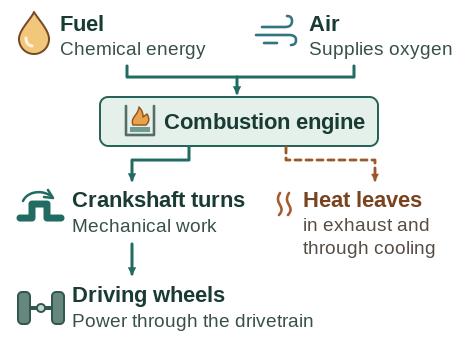
Four things an engine must deliver
A vehicle engineer asks four things of an engine. [2, pp. 173–176] [4, pp. 21–24]
- Torque. Enough turning effort to pull away, climb and accelerate.
- Speed range. Useful torque from a slow idle up to full power.
- Economy. As much work as possible from each gram of fuel.
- Clean exhaust. Unburned fuel, carbon monoxide, nitrogen oxides and particles within the legal limits.
5 steps to learn an engine
Each step answers one question.
- One cylinder. How does burning fuel turn a shaft?
- A whole engine. What limits its work, and which four choices define its type?
- Its numbers. How do you read its torque curve and compare it with other engines?
- Your own design. How do you size an engine with nine relations and a calculator?
- In the car. What does each choice cost, and what does the driver feel?
How it is built, and how it works
One cylinder, four strokes
Everything an engine does begins in one cylinder. The lab below cuts open cylinder 1 of the course’s 1.77 L inline-four engine and leads you through it in seven steps: its parts, the four strokes one by one, and how one cylinder’s pushes become torque, the turning effort at the crankshaft, and power. Press Next to go from card to card; each card plays its part of the motion. Turn the engine yourself at any time by dragging the crankshaft or the slider, and switch to 3D model to see the real parts. [5] [12]
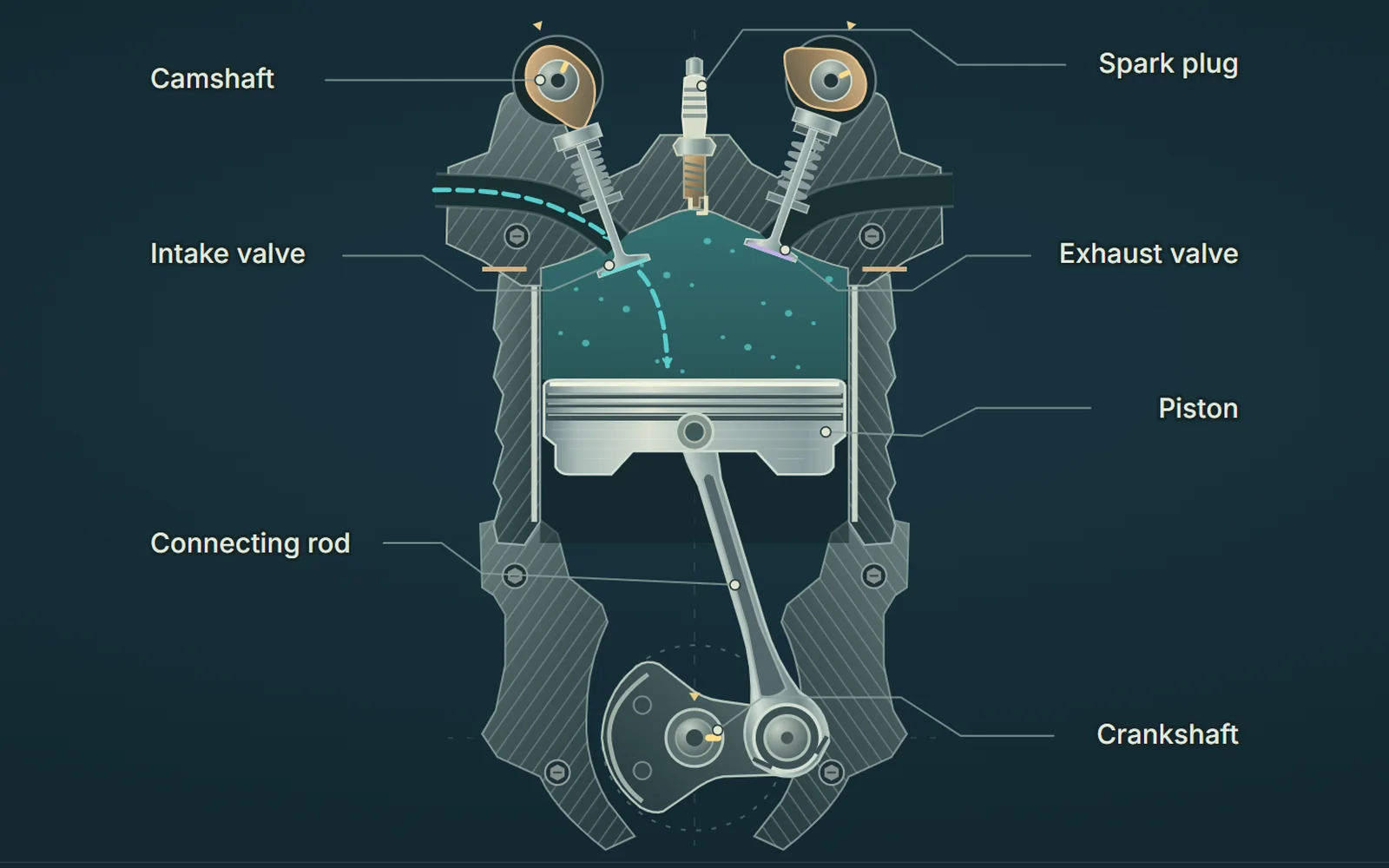
For later reference, here is the cycle in one table. A four-stroke engine needs four trips of the piston, which take two turns of the crankshaft, 720°, for one push. The lab counts the crank angle from the start of intake. The top of the piston’s travel is called top dead center, the bottom bottom dead center. [5]
| Stroke | Crank angle | What happens |
|---|---|---|
| Intake | 0° to 180° | The intake valve is open and the piston moves down. The mixture of air and fuel, blue in the lab, flows into the cylinder. |
| Compression | 180° to 360° | With both valves closed, the rising piston squeezes the trapped mixture. The spark plug fires just before the top. |
| Power | 360° to 540° | The burning gas pushes the piston down, and the connecting rod turns the crankshaft. This is the one stroke that delivers work. |
| Exhaust | 540° to 720° | The exhaust valve is open, and the rising piston pushes the burned gas, gray in the lab, out of the cylinder. |
What the lab shows, and what it does not. The section shows one valve of each kind; each stands for a pair in the four-valve cylinder head, and a camshaft opens it. The piston and the valves move as in the engine model, with the timing of a real engine: the intake valve closes after the bottom, the exhaust valve opens before it, and both are slightly open at the top between exhaust and intake. The colored gas, the spark and the arrows illustrate the process: the lab does not compute pressure, temperature, flow or force. [12]
From one cylinder to an engine
One cylinder gives one push in two turns. At 3,000 rpm the crankshaft turns 50 times a second, so that is still 25 pushes a second. But between two pushes the piston must be carried through three strokes that take work instead of giving it. So an engine joins several cylinders to one crankshaft and lets them fire in turn. In a four-cylinder engine each piston has its own connecting rod, and all four act on the same shaft.
What a test stand measures at the crankshaft is the average of all these pushes, less what the engine spends on itself: compressing the next charge, moving the gas in and out, and friction. Engineers call it brake torque, after the brake that loads the engine on the stand. [1, p. 46] [3, pp. 198–200]
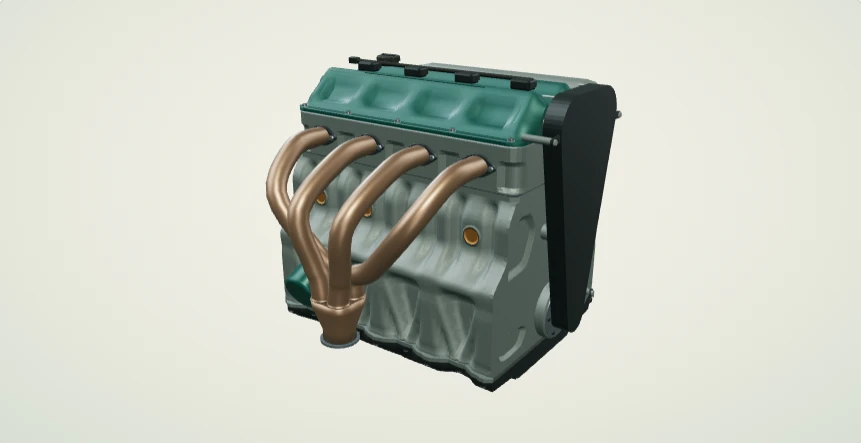
Build an inline four-cylinder engine step by step, find and isolate its parts, and run it through the four-stroke cycle.
What to look for. The lab’s engine is the same inline four of 1,773 cm³. Its cylinders fire in the order 1–3–4–2, and its camshaft turns once for every two turns of the crankshaft, which is what gives each cylinder its four strokes. [12]
What limits the work of one cycle
How hard can one cycle push? Three things decide, and each of them returns below as a design choice.
Air sets the limit
Fuel needs air to burn, so the mass of air in a cylinder bounds the fuel it can burn and the work of the cycle. The volumetric efficiency compares the air an engine draws in with the air that would fill its displacement at the density of the surrounding air. Engines that breathe by themselves reach 80 to 90 % at best. The value changes with speed, which is one reason a torque curve is not flat. [1, pp. 54, 209] [3, pp. 198–199]
The mixture
The air–fuel ratio is the mass of air divided by the mass of fuel. A chemically balanced, or stoichiometric, gasoline mixture holds about 14.6 kg of air for each kg of fuel. Lambda (λ) is the actual ratio divided by the balanced one: below 1 the mixture is rich, above 1 it is lean. Gasoline engines with a three-way catalyst stay close to 1. [1, pp. 53, 301–302] [9]
Timing and knock
Burning takes time, so the spark comes before the piston reaches the top. If the last of the mixture ignites by itself before the flame arrives, the pressure rings through the engine. This is knock, and it limits how far a gasoline engine can compress its mixture. A fuel’s octane rating measures its resistance to knock. [1, pp. 374, 450, 453] [11]
Four choices that define an engine
Every engine answers four questions, and the answers make up its type. A turbocharged inline four-cylinder gasoline engine is four answers in one name.
| The question | The options |
|---|---|
| What ignites the fuel? | a spark (gasoline) or compression (diesel) |
| How often does each cylinder fire? | every second turn (four-stroke) or every turn (two-stroke) |
| How are the cylinders arranged? | in a line, in a V, or flat |
| How does air reach the cylinders? | by itself (naturally aspirated) or compressed (turbocharged) |
What ignites the fuel?
Gasoline: a spark
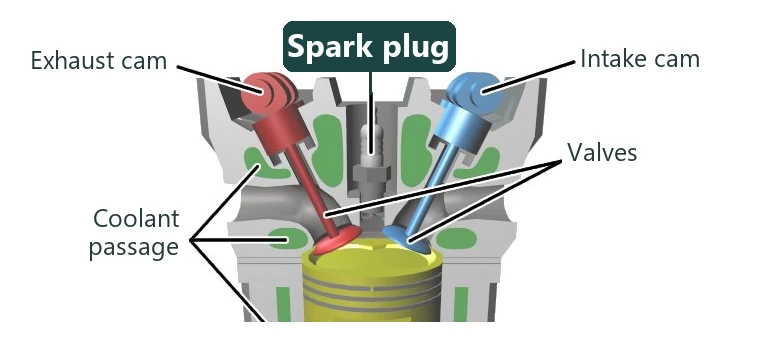

A spark plug ignites the mixture of fuel and air near the end of compression. The fuel is injected into the intake port or straight into the cylinder. [9]
- Advantage. More torque from each liter than a diesel when neither has a turbocharger. [1, p. 50]
- Disadvantage. At light load a throttle holds back the air, and the pistons spend work drawing air past it. [2, p. 196]
Diesel: compression
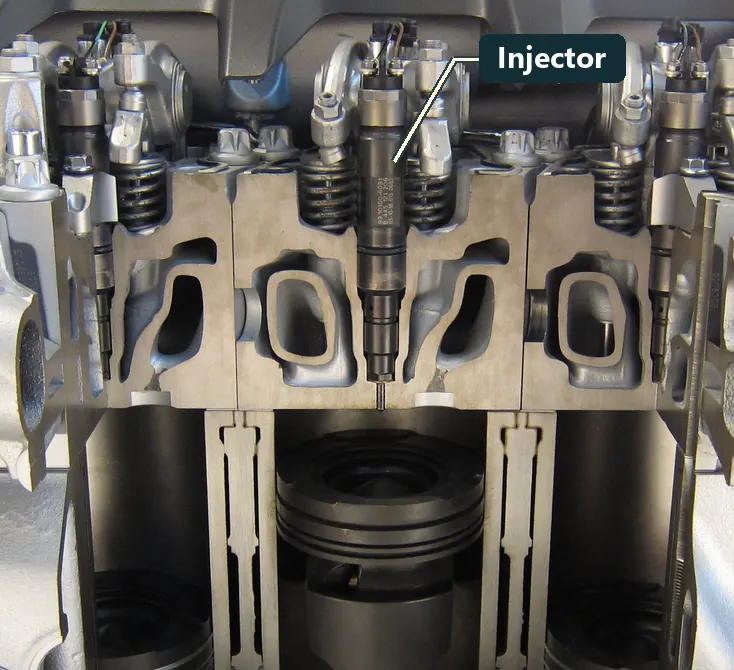

The piston compresses air alone until it is hot enough to ignite fuel. An injector then sprays the fuel into that air. A fuel’s cetane number rates how readily it ignites. [1, p. 541] [10]
- Advantage. Less fuel for the same work. It compresses more, runs lean, and sets its load by the amount of fuel instead of a throttle. [1, pp. 43, 52–53] [2, p. 192]
- Disadvantage. Less torque per liter without a turbocharger, and its exhaust needs a particle filter and a treatment for nitrogen oxides. [1, p. 50] [10]
How often does each cylinder fire?
Four-stroke
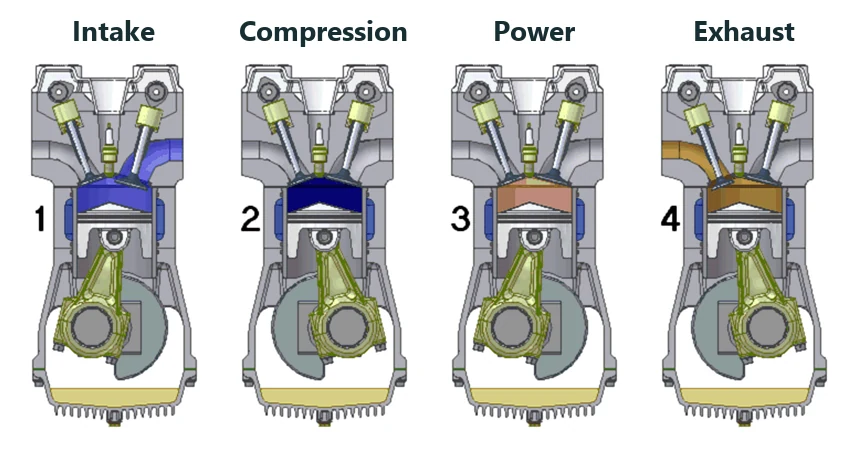

Intake, compression, power and exhaust each get a stroke of their own, so one cycle takes two turns of the crankshaft. [5]
- Advantage. Emptying and filling have their own strokes: the burned gas goes out and the fresh charge stays in.
- Disadvantage. One power stroke per cylinder in two turns.
Two-stroke
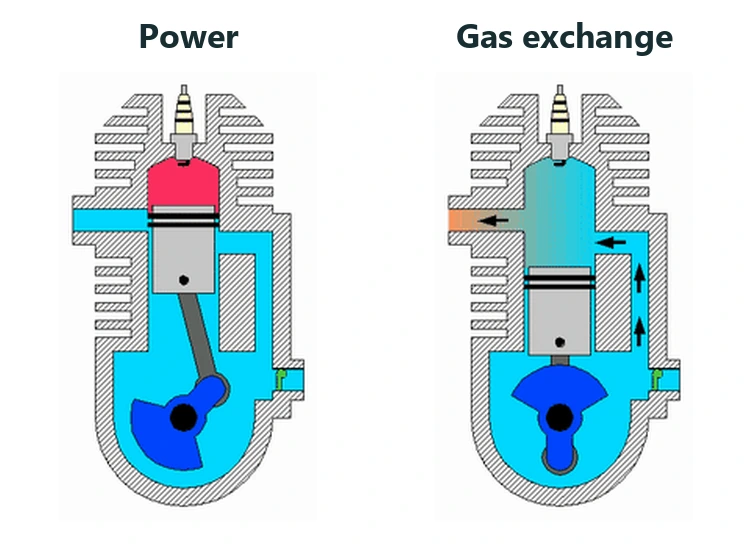

Fresh charge and exhaust change places near the bottom of the piston’s travel, so every downward stroke is a power stroke. [1, p. 235]
- Advantage. Twice as many power strokes as a four-stroke cylinder at the same speed.
- Disadvantage. Little time to empty and refill the cylinder, so some fresh mixture escapes with the exhaust. [1, pp. 240–243, 883]
How are the cylinders arranged?
Inline
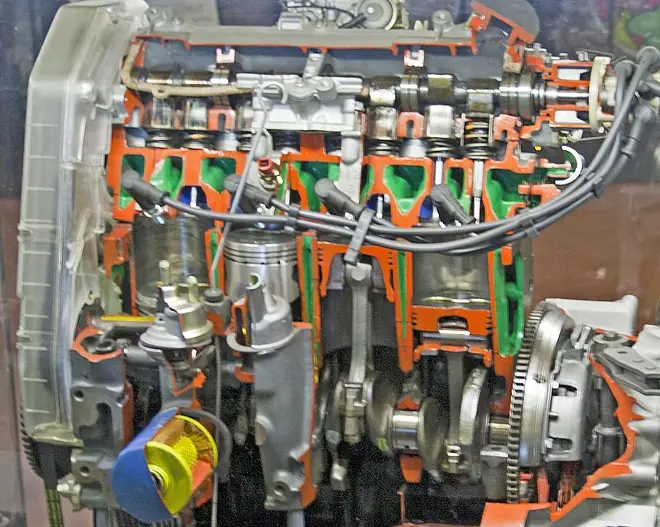

All cylinders stand in one row along the crankshaft.
- Advantage. Narrow, with one cylinder head for all cylinders.
- Disadvantage. Every added cylinder adds length.
V
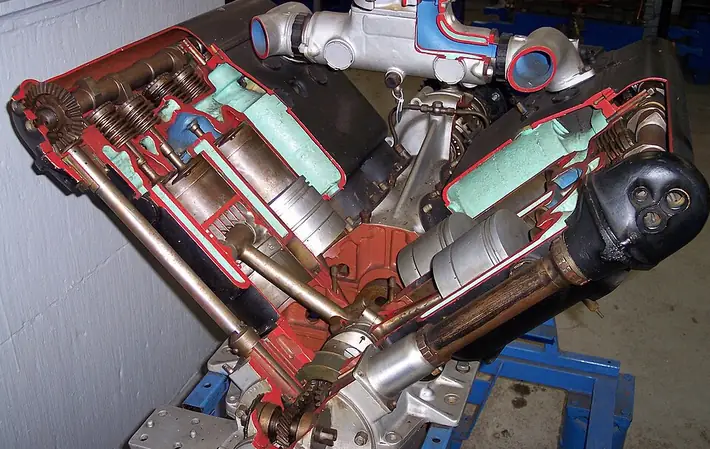

Two rows of cylinders, called banks, meet at an angle above one crankshaft.
- Advantage. Shorter than an inline engine with the same number of cylinders.
- Disadvantage. Wider, with a cylinder head for each bank.
Flat
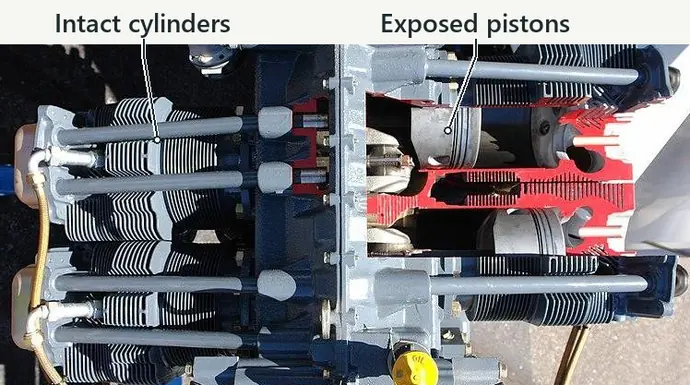

The two banks lie flat, on opposite sides of the crankshaft.
- Advantage. Low.
- Disadvantage. Wide, with a cylinder head on each side.
How does air reach the cylinders?
Naturally aspirated
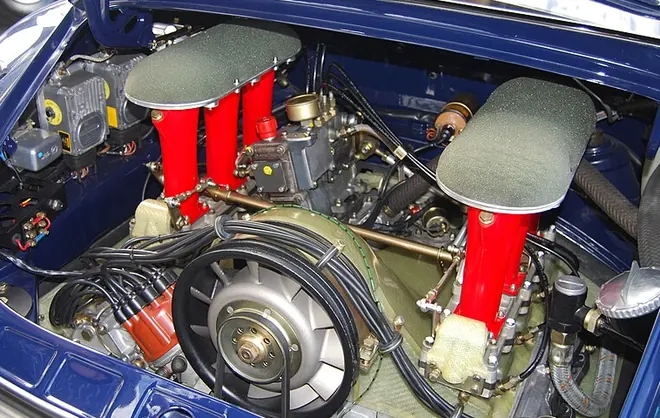

The descending piston draws the air in by itself, at the pressure of the surroundings.
- Advantage. Simple: no compressor and no charge cooler.
- Disadvantage. The air it can draw in limits its torque. [1, pp. 50, 54]
Turbocharged
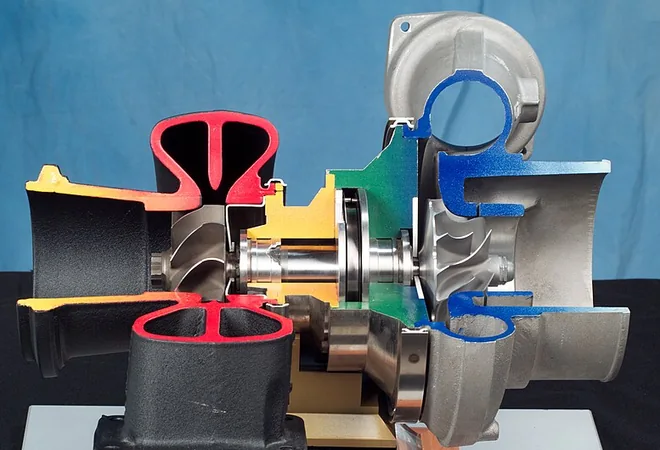

A turbine in the exhaust drives a compressor in the intake. The air enters denser than the surroundings, and a charge cooler makes it denser still. [1, pp. 248–249]
- Advantage. More air, so more torque from the same displacement. [1, p. 50]
- Disadvantage. More parts, and a delay before the pressure builds when the driver asks for torque, called turbo lag.
The numbers that matter
Whatever its type, an engine is a set of cylinders that each deliver a packet of work, many times a second. How big is the packet, and how many arrive each second? That takes numbers, and they start with a curve.
Reading an engine curve
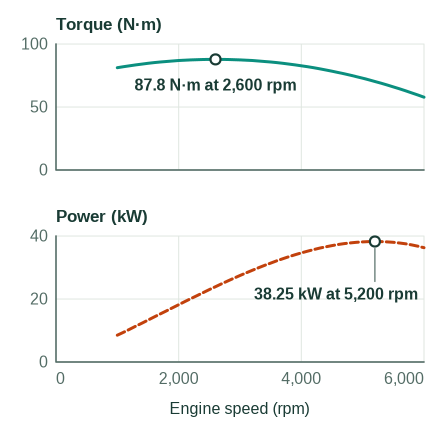
On a test stand an engine is run at full load, the accelerator pressed to the floor, at one speed after another. The result is two curves. Torque says how strongly the engine turns its shaft. Power says how quickly it does work: torque times speed. [4, pp. 21–22]
These curves belong to the reference engine, a small spark-ignition car engine from a textbook example. Its torque peaks at 87.8 N·m at 2,600 rpm. Above that speed the torque falls, but for a while the rising speed more than makes up for it, so the power keeps climbing to its peak of 38.25 kW at 5,200 rpm. [2, pp. 189–190, 193] [3, p. 190]
In everyday driving the engine works below these curves. Its load is the torque it delivers as a share of its full-load torque at the same speed: at 2,600 rpm, 43.9 N·m is half load. The accelerator sets the load. [2, pp. 189, 192]
| Engine speed (rpm) | Torque (N·m) | Power (kW) |
|---|---|---|
| 1,000 | 81.2 | 8.50 |
| 2,000 | 86.9 | 18.19 |
| 3,000 | 87.4 | 27.45 |
| 4,000 | 82.7 | 34.65 |
| 5,000 | 72.8 | 38.14 |
| 6,000 | 57.8 | 36.30 |
Yardsticks that compare engines
Torque and power grow with an engine’s size. To compare a small engine with a large one, engineers divide the size out.
| Yardstick | What it tells you | Unit |
|---|---|---|
| Brake mean effective pressure (bmep) | the work of one cycle for each liter of displacement: how hard each liter works. It is not the pressure in the cylinder | bar |
| Mean piston speed | how fast the pistons travel on average, which is what limits engine speed | m/s |
| Compression ratio | the cylinder volume with the piston at the bottom, divided by the volume with the piston at the top | none |
| Specific fuel consumption | the fuel burned for each unit of work at the crankshaft | g/kWh |
Typical values, for engines in production in 1988, the year of the cited edition:
| Quantity | Gasoline engine | Diesel engine | Source |
|---|---|---|---|
| Compression ratio | 8–12 | 12–24 | [1, p. 43] |
| Bore ÷ stroke, small and medium engines | 0.8–1.2 | 0.8–1.2 | [1, p. 43] |
| Greatest mean piston speed | 8–15 m/s; car engines at the upper end | 8–15 m/s; large marine diesels at the lower end | [1, p. 45] |
| Greatest bmep, naturally aspirated | 8.5–10.5 bar | 7–9 bar | [1, p. 50] |
| Greatest bmep, turbocharged | 12.5–17 bar | 10–12 bar | [1, pp. 50–51] |
| bmep at maximum power, naturally aspirated | 10–15 % below the greatest | — | [1, p. 50] |
| Best specific fuel consumption | about 270 g/kWh; 225 g/kWh on one engine map | lower; below 200 g/kWh in large engines | [1, p. 52] [2, p. 223] |
| Volumetric efficiency at best, naturally aspirated | 80–90 % | — | [1, p. 54] |
| Air–fuel ratio in operation | 12–18 | leaner | [1, p. 53] |
| Fuel flow at idle, 2 L examples | 0.90–0.92 L/h | 0.62 L/h | [2, pp. 191, 194–195] |
Three engines from the textbooks, for scale. The mean effective pressure and the power per liter of the two sports-car engines are computed here from their published figures. [2, p. 193] [3, pp. 188–189]
| Engine | Greatest torque | Maximum power | bmep at greatest torque | Power per liter |
|---|---|---|---|---|
| The reference engine | 87.8 N·m at 2,600 rpm | 38.25 kW at 5,200 rpm | — | — |
| A 7.0 L V8 | 637 N·m at 4,800 rpm | 377 kW at 6,300 rpm | 11.4 bar | 54 kW/L |
| A 3.6 L twin-turbocharged six | 620 N·m at 5,000 rpm | 353 kW at 6,000 rpm | 21.7 bar | 98 kW/L |
The twin-turbocharged engine comes from a 2025 textbook and works its liters far harder than the 1988 range.
The key relations
Each yardstick is a short formula. Nine relations take you from bore and stroke to the force at the road.
| Relation | Formula | Symbols and an example |
|---|---|---|
| Power | power in W, torque in N·m, angular speed in rad/s, speed in rpm. In kW the power is : 120 N·m at 2,000 rpm is 25.1 kW. [1, p. 46] | |
| Displacement | cylinders of bore and stroke . Four cylinders of 86 mm by 86 mm sweep 1.998 L. [1, p. 43] | |
| Compression ratio | is the clearance volume, the space above one piston at the top of its stroke. [1, p. 43] | |
| Torque from mean effective pressure | For a four-stroke engine, whose cycle takes two turns, rad. With bmep in Pa and in m³: 9.2 bar in 1.197 L gives 87.6 N·m. [1, p. 50] [2, p. 190] | |
| Mean piston speed | The piston covers two strokes in every turn. in m, in rpm: 72.5 mm at 5,200 rpm is 12.6 m/s. [1, pp. 44–45] | |
| Efficiency and fuel | fuel flow in kg/s, heating value in J/kg, specific fuel consumption in kg/J. With 44 MJ/kg, for in g/kWh: 270 g/kWh is 30 %. [1, pp. 51–52] [2, pp. 191–192] | |
| Air and torque | volumetric efficiency, air density, lambda, the balanced air–fuel ratio. 0.303 × 0.822 × 1.2257 kg/m³ × 44 MJ/kg ÷ 14.6 is 9.2 bar. [1, pp. 53–57] | |
| The full-load curve | Artamonov’s relation for gasoline engines, with the maximum power at the speed . The reference engine follows it. [2, pp. 189–190] [3, pp. 187–188] | |
| To the road | overall gear ratio, driveline efficiency, wheel radius. Multiplied, : gears trade force for speed, and power is the ceiling. [3, pp. 196–198] [4, pp. 26–28] |
The design instrument: sizing an engine
With these relations you can size an engine yourself. Suppose the reference engine did not exist yet and you had to design it: an engine that gives 87.8 N·m. The calculator starts from one answer, four cylinders with a bore and a stroke of 72.5 mm at a mean effective pressure of 9.2 bar, and shows it against the reference engine’s curves. Change the design and watch what follows. [7]
The engine sizing calculator
This design instrument needs JavaScript. The text around it explains what it shows.
Try this
How big? Read the start values.
1.197 L at 9.2 bar gives 87.6 N·m, within 0.2 % of the reference engine’s 87.8 N·m. At 2,600 rpm that is 23.9 kW.Hold the pressure, raise the speed. Move the engine speed to 5,200 rpm.
The torque stays at 87.6 N·m and the power doubles to 47.7 kW, above the reference engine’s 38.25 kW. A real engine cannot hold its pressure that far, which is why the reference curve bends down.Match maximum power. At 5,200 rpm, lower the pressure to 7.40 bar.
70.5 N·m and 38.4 kW, the reference engine’s maximum power. On its curve the pressure at maximum power is 20 % below the greatest. The textbook gives 10 to 15 % for gasoline engines without a turbocharger.How fast? Stay at 5,200 rpm, read the mean piston speed, then raise the stroke to 90 mm.
With 72.5 mm the pistons average 12.6 m/s and would reach 15 m/s at 6,207 rpm. With 90 mm they are already past the mark at 15.6 m/s, and the calculator says so.Half load. Reset and halve the pressure to 4.60 bar.
43.8 N·m at the same 2,600 rpm: the load of this design reads 50 %. The accelerator moves an engine between such points.Fuel. Reset and change the specific fuel consumption from 270 to 225 g/kWh.
The brake efficiency rises from 30.3 % to 36.4 %, and the fuel flow falls from 6.4 to 5.4 kg/h.Enough air? Reset and read the air needed and the cylinder filling.
94.1 kg/h of air, 82 % of what the displacement would hold at the density of the surrounding air. That is inside the 80 to 90 % that engines reach without a turbocharger.Downsize. Set three cylinders with a 70 mm bore and a 75.5 mm stroke, 17 bar and 2,000 rpm.
0.872 L now gives 117.9 N·m: 35 % more torque from 27 % less displacement. But it needs 152 % filling, far more than an engine can draw in by itself, so the air must arrive compressed. This engine needs its turbocharger.A textbook design. Press the button for the textbook’s 2.0 L example.
Heywood sizes a four-cylinder engine for 150 N·m at about 3,000 rpm with 925 kPa at the torque peak, 800 kPa at maximum power and a mean piston speed of 15 m/s. With a bore equal to the stroke, 86 mm, the calculator gives 1.998 L and 147.1 N·m, and 15 m/s at 5,233 rpm, close to the example’s 5,200 rpm. Set 5,200 rpm and 8.00 bar to read the maximum power, 69.3 kW.
What the calculator assumes. One steady operating point of a four-stroke gasoline engine. The mean effective pressure and the specific fuel consumption are inputs, not predictions: the calculator does not know how well a particular engine breathes or burns.
- The reference engine is a textbook example: Artamonov’s full-load curve with the peak of Genta and Morello’s Example 22.1, used from 1,000 to 6,000 rpm, an assumed range. The same engine drives the gear-ratio designer on the Transmission page. [2, pp. 189, 193]
- The start design is this page’s assumption. The book gives the reference engine’s power curve but not its dimensions. [7]
- Fuel: a heating value of 44 MJ/kg. 270 g/kWh is Heywood’s best value for gasoline engines, and 225 g/kWh is the best point of one of Genta and Morello’s engine maps. [1, p. 52] [2, pp. 191–192, 223]
- Air: a balanced gasoline mixture, 14.6 kg of air for each kg of fuel, drawn from air of 1.2257 kg/m³, the standard atmosphere at sea level. The filling shown is what the chosen point requires, not what an engine achieves. [1, p. 54] [2, pp. 128–129]
- The 15 m/s mark is the top of Heywood’s range for the greatest mean piston speed. [1, p. 45]
- The textbook’s 2.0 L example takes its torque, pressures and piston speed from Heywood. The 86 mm bore and stroke and the results are the calculator’s. [1, p. 51]
Trade-offs
Every slider in the calculator is a choice, and every choice has a price.
| The choice | What it gains | What it costs |
|---|---|---|
| A short stroke with a wide bore, at the same displacement | a higher engine speed before the pistons reach 15 m/s, so more power from the same torque [1, p. 45] | wider cylinders, so a longer row of them |
| A turbocharger and a smaller displacement | the same torque from fewer or smaller cylinders, at 12.5–17 bar instead of 8.5–10.5 bar; one of the three main ways to cut fuel consumption [1, p. 50] [2, p. 196] | more parts, and turbo lag |
| A diesel instead of a gasoline engine | less fuel for the same work [1, p. 52] [2, p. 192] | less torque per liter without a turbocharger, 7–9 bar against 8.5–10.5 bar, and more exhaust treatment [1, p. 50] [10] |
| A large engine, lightly loaded | torque in reserve at every speed | more fuel: a gasoline engine is most efficient near full load, at about the speed of its greatest torque, and it loses efficiency quickly below that [2, pp. 192, 199] [3, p. 190] |
In the vehicle
These choices are made at the drawing board. In the car they show up under the driver’s right foot. From the driver’s seat the engine is a pedal and a sound; this is what happens behind them.
The accelerator
The driver’s foot sets the load. Pedal down, the engine gives its full-load torque for the speed it turns at. Pedal up with a gear engaged, the wheels turn the engine and the engine brakes the car, which drivers use on long descents. Chapter 5, Drivetrain starts from the same idea: a torque requested at the wheel. [2, pp. 299, 304, 311]
Through the gears
At 2,600 rpm and full load the reference engine gives 87.8 N·m. In the lab car’s first gear, with an overall ratio of 15.91, a driveline efficiency of 0.90 and a wheel radius of 0.317 m, that is 3,967 N at the road at 19.5 km/h. In fourth gear the same engine point gives 1,072 N at 72.2 km/h. Force times speed is 21.5 kW both times. The Transmission page draws this for every gear. [3, pp. 196–198] [4, pp. 26–28] [8]
Two limits
At high speed the engine’s power is the ceiling: at 100 km/h no gear can give more than 0.90 × 38.25 kW ÷ 27.8 m/s = 1,239 N. At low speed the grip of the tires can be the limit instead. Chapter 10, Longitudinal dynamics works that out. [3, p. 187] [4, pp. 21, 35]
Fuel
In everyday driving an engine works far from its best point, so only about 20 to 30 % of the fuel’s energy reaches the crankshaft, against 30 to 36 % at the best points above. At idle it delivers no useful work and still burns 0.6 to 0.9 L/h in the 2 L examples. [1, p. 52] [2, pp. 174, 191–199, 223]
Standing still
A combustion engine cannot run below a lowest speed, so a car needs a clutch or a torque converter to stand still with the engine running and to move off. The Power Transmitting Unit page, the next one, shows both. [2, pp. 281–283] [3, p. 200]
Reaction
The torque that drives the wheels has a reaction on the car. On a rigid driven rear axle the drive shaft’s torque tries to roll the axle, which loads one driven wheel more than the other. Chapter 5 locates the reaction for each kind of drive. [4, pp. 35–38]
Sources
- J. B. Heywood, Internal Combustion Engine Fundamentals, McGraw-Hill, 1988, pp. 43–46, 50–54, 56–57, 209, 235, 240–243, 248–249, 301–302, 374, 450, 453, 541, 883.
- G. Genta and L. Morello, The Automotive Chassis, vol. 2, System Design, 2nd ed., Springer, 2020, pp. 128–129, 173–176, 189–199, 223, 281–283, 299, 304, 311. Publisher
- R. N. Jazar, Vehicle Dynamics: Theory and Application, 4th ed., Springer, 2025, pp. 187–190, 196–200. Publisher
- T. D. Gillespie, Fundamentals of Vehicle Dynamics, 1st ed., SAE International, 1992, pp. 21–24, 26–28, 30–32, 35–38. Publisher
- U.S. Department of Energy, “Internal Combustion Engine Basics,” 2013. How an engine works, and the four strokes. Page
- F. Stabler, “Automotive Thermoelectric Generator Design Issues,” DOE Thermoelectric Applications Workshop, San Diego, 2009. The energy-flow reference for the first diagram. Slides
- Axle-V, Engine sizing calculator, 2026-11-18, unpaginated. The calculator’s start design and its hand-checked reference cases.
- Axle-V, Transmission explorer and gear-ratio designer, 2026-11-16, unpaginated. The lab car’s gear ratios, driveline efficiency and wheel radius.
- U.S. Department of Energy, Alternative Fuels Data Center, “How Do Gasoline Cars Work?” Fuel injection into the intake manifold or the combustion chamber; the three-way catalyst. Page
- U.S. Department of Energy, Alternative Fuels Data Center, “How Do Diesel Vehicles Work?” Ignition by the heat of compression; exhaust treatment. Page
- U.S. Department of Energy and U.S. Environmental Protection Agency, “Selecting the Right Octane Fuel,” fueleconomy.gov. Octane rating and knock. Page
- Axle-V, Inline-four engine model, four-stroke lab and engine assembly lab, 2026-11-18, unpaginated. The model’s dimensions, firing order and valve motion, and what the two labs show.